Datastreams
    Declarative model language

    Describe the operation once.
    Run it as a governed stream.

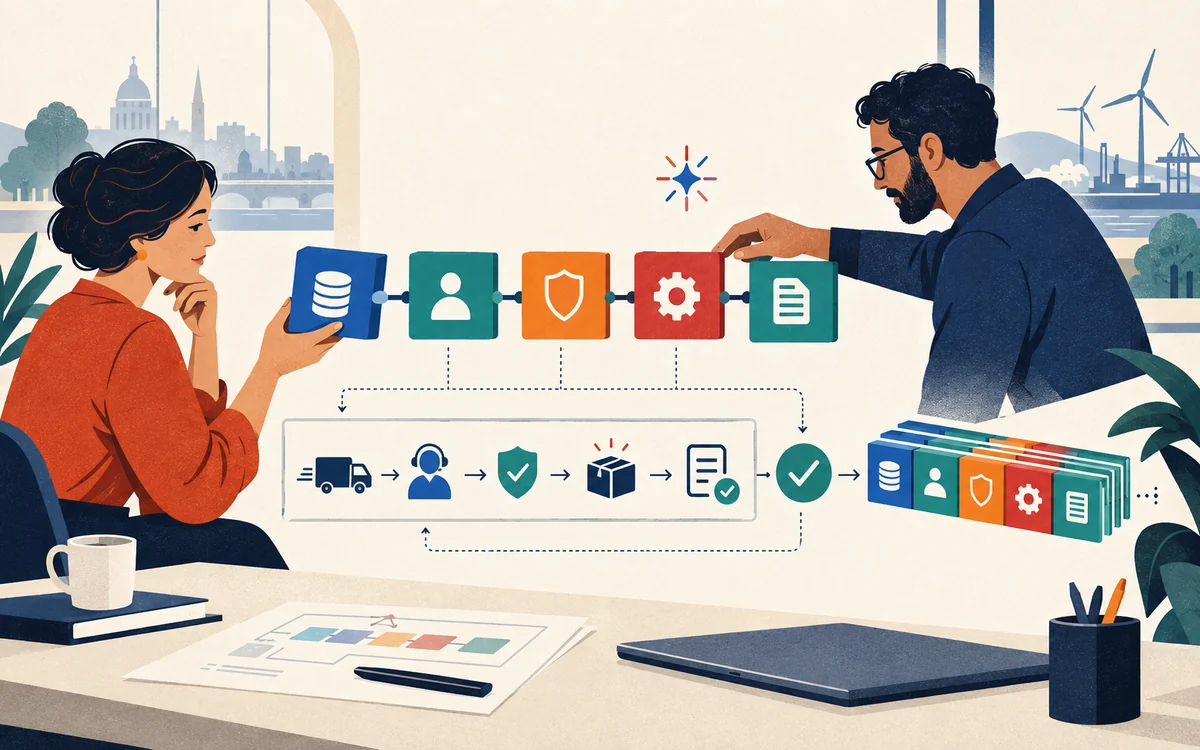
    A stream configuration keeps source, meaning, context, processing grounds, rules, destinations, permitted actions and evidence together as one versioned model that the runtime can execute.

    One runtime can execute many independently versioned recipes. Capacity is verified against the actual workload.

    The configuration contract

    Everything required to turn an event into an accountable outcome.

    The definition travels with the operation instead of being scattered across pipeline code, cloud consoles and team knowledge.

    01

    Source and contract

    What may enter the stream, which structure it must follow and how invalid events are handled.

    02

    Context and processing grounds

    Which current state, identity, consent, purpose, legal basis, provenance or external context applies while the event moves.

    03

    Rules and decisions

    Which deterministic conditions, validations and permitted decisions the runtime executes.

    04

    Destinations and actions

    Where validated data may go and which systems, people or approved agents may act.

    05

    Evidence and recovery

    Which version, decision trace, result and recovery information must remain available.

    Readable configuration model

    A business operation that people and agents can understand.

    This example shows the content model, not unverified command syntax. Published CLI examples will use the exact commands and output contracts of the current Datastreams CLI.

    stream:
      source: customer_activity
      contract: activity.v1
      context:
        - customer_permissions
        - current_session
      rules:
        - allow_permitted_purpose
        - reject_invalid_identity
      destinations:
        - operations_store
        - approved_agent
      evidence:
        retain: decision_trace

    AI-assisted, declarative by design

    Describe and test with AI. Publish through governed control.

    AI can translate business intent into a model proposal and help explain or test it. It does not bypass the configuration contract, organisational policy or production approval.

    Describe with AI

    Turn a natural-language operation, example events and business rules into a readable configuration proposal.

    Review the model

    Expose every source, field, processing purpose, legal basis, rule, destination and proposed change as an explicit diff.

    Validate and test

    Check contracts, references, authority and representative events before production state can change.

    Approve and publish

    Activate an authorised version on the runtime through the controlled UI, CLI or agent lifecycle.

    One model, more responsibility

    A personal-data stream is not a different platform.

    It uses the same source-to-outcome definition. The regulated operation simply makes more context, policy and evidence explicit.

    Simple data delivery

    source: orders
    contract: order.v1
    destination: operations

    Personal and regulated data

    source: customer_activity
    contract: activity.v1
    context: [identity, consent, purpose]
    processing_basis: approved_legal_basis
    rules: [permitted_use, retention]
    destination: permitted_operations
    evidence: decision_trace

    Conceptual configuration model. Exact fields and CLI commands are published only after validation against the current runtime implementation.

    Runtime insight per recipe

    See what is running, why it may run and what it produced.

    Each active configuration keeps operational and governance insight at recipe level, even when hundreds of different data operations share the runtime.

    01

    Active version, publisher and approval evidence

    02

    Declared purpose and approved legal basis

    03

    Accepted, rejected, retried and recovered events

    04

    Rules, policy outcomes and permitted actions

    05

    Processing time, active state and delivery behaviour

    06

    Destinations, provider adapters and resulting evidence

    The accountable organisation determines and approves the processing purpose and legal basis. Datastreams makes the declared basis and resulting runtime decisions inspectable; it does not provide an automated legal conclusion.

    Controlled lifecycle

    From proposal to production without hidden changes.

    The lifecycle is the contract for both human and agent operators. Exact CLI command names will be bound to the current implementation before publication.

    1. 01

      Describe

      Read the active stream, its contract, capabilities and operating boundaries.

    2. 02

      Validate

      Check structure, references, permissions and compatibility before a change can progress.

    3. 03

      Diff

      Show exactly how a proposal differs from the active configuration.

    4. 04

      Dry-run

      Evaluate representative events without changing the live stream.

    5. 05

      Approve

      Apply the organisation’s policy and human approval requirements.

    6. 06

      Apply

      Activate an approved version through the runtime control plane.

    7. 07

      Inspect

      Observe state, decisions, failures, actions and downstream results.

    8. 08

      Rollback

      Return through a controlled process to a known configuration version.

    Agent-operable, policy-bound

    Agents can operate the platform without becoming the platform authority.

    An approved agent works through the same configuration, validation and evidence model. Company-defined policy remains authoritative.

    Read and inspect

    Understand active streams, permitted capabilities, state, failures and downstream effects.

    Propose and compare

    Create a versioned proposal, validate it and expose the complete diff before approval.

    Apply only when permitted

    Request approval and activate only within policy, identity and environment boundaries.

    Configuration library

    Reusable patterns grounded in real runtime jobs.

    A public library should contain verified, sanitised configurations, not fictional popularity, authorship or deployment statistics.

    Customer activity

    Validate interaction events, attach consent and current context, then route analytics and permitted actions.

    Transactions and risk

    Evaluate a payment or order while it moves and intervene before it becomes a delayed warehouse record.

    Operational exceptions

    Detect incomplete, late or inconsistent events and route them to a system, person or approved agent.

    Documents and messages

    Extract, validate and enrich incoming information before it enters operational systems.

    Devices and telemetry

    Apply contracts, state and operating rules to high-volume machine events in real time.

    Multi-destination delivery

    Deliver one governed event to operational, analytical, archival and agent consumers without rebuilding the stream.

    Provider replacement

    Validate and approve a compatible source, identity, trust, payment or destination adapter while preserving the stream contract and audit history.

    Turn one real data flow into the first verified configuration.

    We start from the actual source, contract, rules, deployment and required outcome, then prove it against representative events.