
One controlled service definition.
Use it from VS Code, CLI or MCP.
DimML is the declarative language behind a Datastreams data service. Technical teams inspect and version it in Visual Studio Code, automate its lifecycle through the Datastreams CLI and let approved agents work through scoped MCP tools. The same validation and approval boundary applies to every interface.
The model describes the operation. The Datastreams runtime executes the approved version.
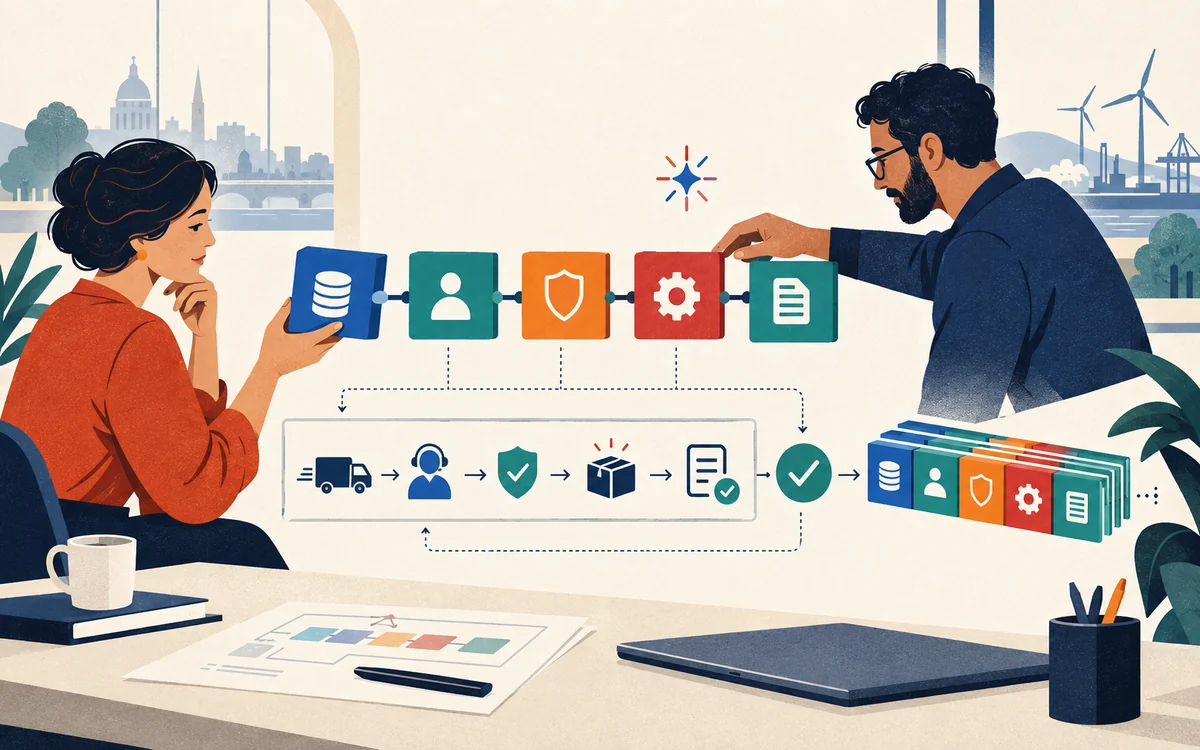
An unforeseen match with AI
The abstraction built for controllable data operations is exactly what AI needs.
DimML was created to separate business meaning and operating rules from implementation code. That same separation gives AI a compact, explicit model it can help create, reason about, explain and test.
AI does not need to invent an entire infrastructure stack or interpret behaviour scattered across functions, queues and integrations. It works on a bounded proposal whose sources, contracts, rules, state, permissions, destinations and evidence can be reviewed together.
The abstraction boundary
business intent + data agreements
↓ DimML model
validate + test + approve
↓ Datastreams runtime
answers + actions + permitted outputs + evidence
The model remains the inspectable contract. AI can assist at every step without becoming the source of truth or the production authority.
One language for data in motion
Model intelligence, distribution and events as one operation.
The same language connects what arrives to the context, decisions and outcomes that belong together. Storage is included only when the operation needs state, history or evidence.
Streaming intelligence
Describe how an arriving signal is validated, combined with current context and turned into an answer, decision or action.
Controlled data distribution
Define which output goes to which ledger, application, partner or agent, under the conditions that apply to that recipient.
Complex event processing
Recognise patterns across events, maintain the state needed for a decision and respond while the business situation is still current.
One technical workflow
Visual Studio Code, the Datastreams CLI and MCP work on the same controlled service.
People, automation and approved agents use the same project artefacts and the same visible route from proposal to production. Every change can be reviewed before the runtime changes.
- 01
Model in Visual Studio Code
Inspect and edit the service definition alongside the rest of the project, with a clear diff for every proposed change.
- 02
Validate with the CLI
Use the Datastreams command-line workflow to validate and test the definition before changing a runtime.
- 03
Assist through MCP
Approved AI clients use scoped Datastreams tools to inspect the operation and prepare reviewable proposals.
- 04
Approve and publish
A person or authorised policy gate decides which reviewed version may become active on the selected runtime.
describe → model in VS Code → validate with CLI → assist through MCP → review → approve → publish → inspect
Agent-operable, not agent-uncontrolled
Agents can operate the runtime through an explicit contract and authority boundary.
The DimML toolchain gives an agent a defined route to inspect, prepare, validate, test and operate. Credentials, policy and approval determine what that agent may actually change.
Read the active model and explain what the operation does
Prepare a proposed change from an approved business instruction
Validate and test the proposal before it reaches production
Show the exact difference in sources, rules, permissions and outputs
Publish only through the identity and approval boundary provided to it
Inspect runtime state, processing results and delivery evidence
Why declarative matters
Review the intended behaviour, not an infrastructure reconstruction.
A DimML change shows what the business operation is meant to do. Teams do not have to infer the same meaning from application code, deployment templates, service consoles and integration logs.
One runtime, many models
Add operations without building another technology stack.
Independently versioned DimML models can share the same runtime. Capacity and deployment remain workload-specific, while every operation keeps its own rules, lifecycle and evidence.
Bring one business rule that is currently buried in code.
We will map the source, context, decisions and outputs and show how it becomes an explicit in-motion operation.