
Record, intelligence and agents.
One governed event loop.
Each event can update trusted state, use context to reach a decision and trigger a permitted action. One runtime keeps those three layers connected and produces the evidence needed to understand what happened.
The architecture describes responsibilities, not a compulsory cloud product stack.
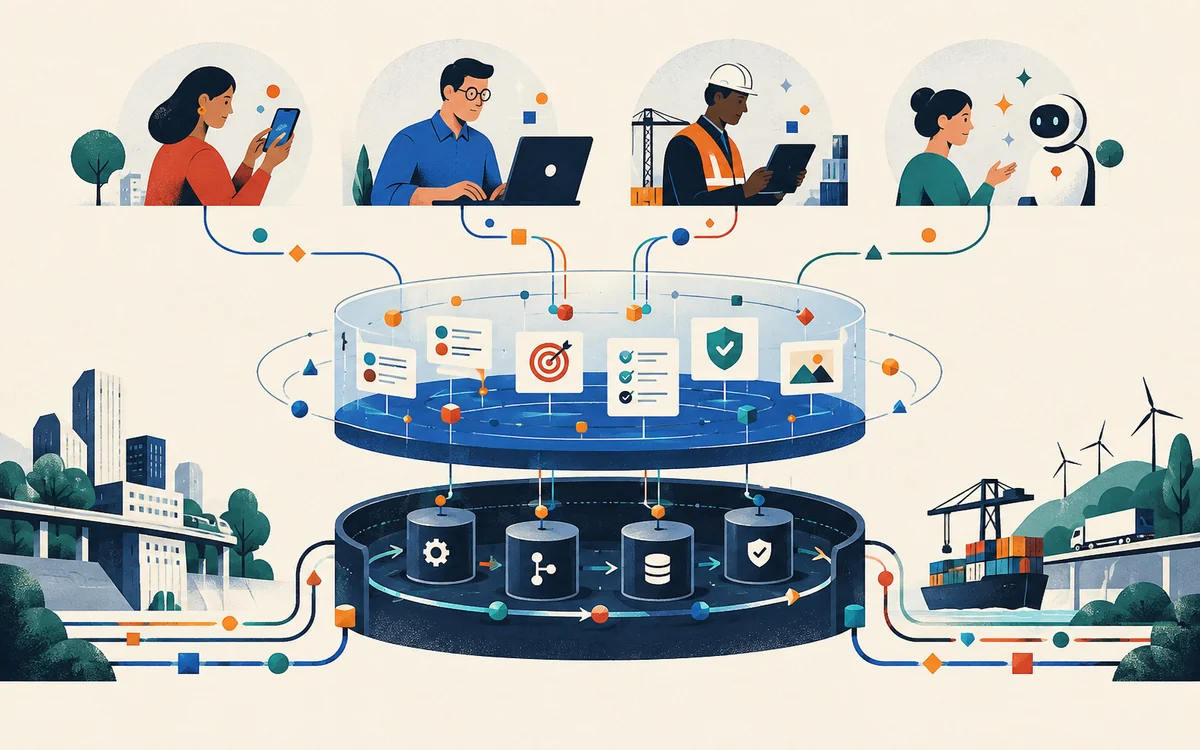
The three layers
From an event to an accountable outcome.
The layers are different responsibilities inside one continuous operation, not three platforms that the customer has to integrate.
Record
Know what happened and which state is authoritative.
Validated events, business records, history and provenance form the operational source of truth. State can be reconstructed from evidence instead of inferred from disconnected copies.
- Contracts and event history
- Current business state
- Lineage and retention evidence
Intelligence
Decide from live context inside explicit policy.
Business rules, transformations, models and contextual signals evaluate the event while it moves. A model is a replaceable capability; the operation remains authoritative.
- Validation and enrichment
- Rules and model outcomes
- Context and drift signals
Agents
Act without giving automation unlimited authority.
People, applications and approved agents invoke permitted actions through the same contracts. Proposals, approvals, execution and results remain inspectable.
- Policy-bound actions
- Human approval boundaries
- Execution and outcome evidence
One event loop
Observe → understand → decide → act → prove.
The result of an action becomes new operational state and context for the next event. That feedback loop is why Datastreams treats records, intelligence and agents as one runtime concern.
What the runtime does
The complete operation stays in one execution model.
The customer specifies the outcome and authority boundaries. Datastreams carries the agreed technical responsibility for executing and servicing that definition.
- Accept and validate events against the active contract
- Maintain the context and state required for the next decision
- Execute rules, transformations and approved model calls
- Route permitted outcomes to declared destinations
- Record configuration, decision and recovery evidence
- Expose one controlled lifecycle to people and approved agents
Stable configuration shape
source
contract
context
rules
action
evidence
A simple delivery can use only what it needs. Identity, consent, models, signatures or payments add explicit conditions to the same definition rather than another architecture.
How it is operated
Runtime, control plane and adapters have clear boundaries.
This separation preserves infrastructure choice and makes changes reviewable without fragmenting the business operation.
Runtime
The execution engine processes the stream, state, rules and actions. It can run as a Datastreams-managed service, on dedicated infrastructure or on-premise.
Control plane
A UI, CLI or approved agent reads and proposes changes through the same validation, approval, inspection and rollback lifecycle.
Adapters
Sources, destinations, identity, trust, payment and AI services remain behind versioned contracts so compatible providers can be replaced deliberately.
Test the architecture against one real stream.
Bring the source, live context, rules, required action and evidence. We will map what belongs in the runtime and what stays with your organisation or chosen providers.